
Objectives and approach of the SupMed project

The project aims to reduce the overexploitation of water ressources in a structural and sustainable way and to improve the farmers household revenus in Lebanon and Egypt in a context of climate change.

For that, it will propose, implement and assess integrated agronomic and socio-economic intitiatives based on agroecology in order to reduce water dependance in both territories.

These initiatives will be concerted with local stakeholders and adapted to the local contexts, i.e the Bekaa Valley in Lebanon and the Governorate of Luxor in Egypt. Finally, the project aims the subscription of at least 400 farmers by territory to a Charter for the implementation of adaptation strategies based upon agroecologic practices.

From an institutional point of view, the project aims to improve and give a better structure in terms of agricultural advisory, public-private partnership being very limited today in both countries. It comes to capitalize around this experience of partnership and to formulate recommendation for future agricultural policies. This capitalization work will be important as the project will contribute (even partially) to the elaboration of the future national agricultural policies (Lebanon) and to regional policies (Egypt).

The three specific objectives (SO) of the project are

SO1

Preserve water resources by decreasing the quantity of irrigation water wasted due to the poor state of the infrastructures.

SO2

Improve the management of irrigation water demand and the agricultural households incomes by adopting agroecological practices. It aims to build, implement and assess adaptation and mitigation strategies based on agroecology against climate change in a participative approach. This main objective will be composed of an agricultural households modelling phase and an on field implementation phase, first with farmers involved in the project and then with all the voluntary farmers located in the target areas.

SO3

Capitalize the project results and contribute to national strategies linked to climate change by assessing on one hand the replication modalities of the initiatives aimed in target areas and, one the other one, by contributing to private and public partnership structuration for agricultural advisory.

Contents of the programme

This component aims to implement or strenghten water irrigation infrastructure to develop sustainable practices using less water in the Bekaa valley and the Luxor Governorate.

In Lebanon, there is no water management supply, it is currently based only on an overexploitation of a non renewable groundwater with uncontrolled private wells.

The construction of hills lakes aims to reduce the number of these wells and the pressure on grounwater (due to the fact that the lakes will be supplied by renewable water from the melting snow) and more globally to save water resources by giving the farmers the possibility to adopt more efficient water irrigation systems (drip irrigation) and to diversify their crops.

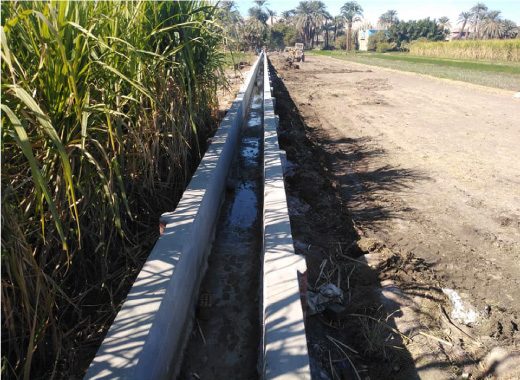
In Egypt, water supply management from the Nile exists but irrigation systems are old and the water loss by evapotranspiration is estimated to more than 40%. The project aims to implement new covered irrigation systems in order to decrease the water loss to less than 10% (in accordance with international standards).

First, it aims to identify available statistics through ongoing projects, and the main agricultural stakeholders of each territories with specific fields survey and to characterize the agricultural households diversity.

Then, a discussion phase for the co-building of the adaptation/mitigation strategies to climate change will occur. This choice will be made jointly with local stakeholders of the area (farmers, agricultural advisors, representatives from the Ministry of Agriculture, coops…) through several workshops. This approach will also involve representative farmers to precise the issues which they have to face.

The strategies will combine 3 types of criteria : (i) agronomic and environnemental, relying on agroecology as a production principle to improve soil fertility and agricultural production and to reduce irrigation water consumption, (ii) socio-economic criteria by analyzing the risk on existing value-chains, and (iii) organizational by proposing and testing new collective strategies of production (water user association for example) or incentives (like agrienvironmental measures) for a sustainable production.

This tool will especially rely on the DHABSIM model developed by CIHEAM IAMM in close collaboration with ICARDA and IFPRI, in the framework of its research and cooperation projects to simulate, ex-ante, the socio-economic and environnemental performances of the whole strategies proposed above (see Component 2). This model has been tested and used with farmers and agricultural advisers to elaborate adaptation strategies to face weed resistance to phytosanitary treatment problems, in France (with coops and private sector), in Malawi to improve agricultural efficiency of agricutural systems based on maize production (with the participation of agricultural households) ; and in Morocco to adapt and test adaptation strategies for sustainable intensification of cereals systems in socio-economic and climate change uncertain context (with the participation of 250 farmers from the Meknès plain).

After a configuration and contextualization phase, using the collected datas on the characterization and the functionning of the farms  coming from component 2; a simulation phade will be carried out with the model based on the strategies previously selected in component 2. Only ecologically, economically and socially acceptable strategies will be selected to be applied and disseminated first to the representative farmers and then to all of them inside the target areas (see Component 4). This selection will be also collective with the participation of local stakeholders.

Apart from the project duration, the designed and configurated model will thus be used by agricultural advisers of extension centres, NGO’s and research centres in both countries to build and assess, ex-ante, other adaptative strategies to face other socio-economic or environnemental issues.

Agricultural representative households (160) will be chosen to apply, in accordance with a pre-formated contract, the adaptation and mitigation strategies collectively selected at the end of Component 3 activities. Requirement specification will be elaborated for each strategy to test on the field, precising the production practices modalities to be respected according to a specific production contract. The objective is to demonstrate to different stakeholders of the target area the importance of these adaptation and mitigation strategies and to assess their effects. The monitoring and performance indicators identified in component 2 will be completed and discussed with the stakeholders during this step of implementation and demonstration.

Several activities will be organized to train the different agricultural stakeholders  including decision makers at local level   as well as value-chain operators  to know more about the  notion of climate change and the necessary prerequisites to elaborate and assess integrated and participative strategies during the project. The planned training will also help to disseminate to all the farmers of the target area and to other field stakeholders some technical supports proposing specific and differentiated adaptation and mitigation strategies, i.e considering the households structure, their access to resources and their production objectives. These technical sheets will be elaborated by taking into account the results of a bio-economic simulation model and the results based on field experience (Component 3 & 4).

The project also seeks to strenghten the capacity of stakeholders  in charge of agricultural advisors by creating spatial and multi-scalar data bases for each Region and Governorate that will allow a better understanding of the current  functioning of the agricultural systems, to propose and assess mitigation and adaptation strategies to climate change and, to implement an alarm system to face specific climate change eventThese data bases will be  developed from bioeconomic modelling and plots results and diagnostic activities.

From an institutional point of view, this project should lead, by involving, decision-makers on-time to recommendations for incentive measures,  in particular agrienvironmental ones, to promote innovative mitigation and national or territorial strategies to face climate change.

Finally, SupMed has the ambition to disseminate its results widely (especially  in dry lands) through comparative analysis, scientific publications, seminars and other communication media showing the importance of the approaches used in this project and their replicability, and highlighting the potentially extrapolable results.

This component represents the activity of governance, coordination, selection of national and international experts and monitoring of the project. The CIHEAM IAMM, as leader of this component will be in charge of the good execution of the project.